
MURDER, POLITICS, AND THE END OF THE JAZZ AGE
by Michael Wolraich


I'm going to try and keep this short and sweet. The basic point I want to drive home is this: Climate change is occurring, but "cap and trade" policies will not stop it.
While "cap and trade" seems to offer a sensible policy prescription for reducing carbon emissions, marginal, near-term reductions in atmospheric carbon dioxide will not put a halt to climate change. In order for me to explain why, I'm going to set down a few of the facts about climate change so that we're all on the same page.
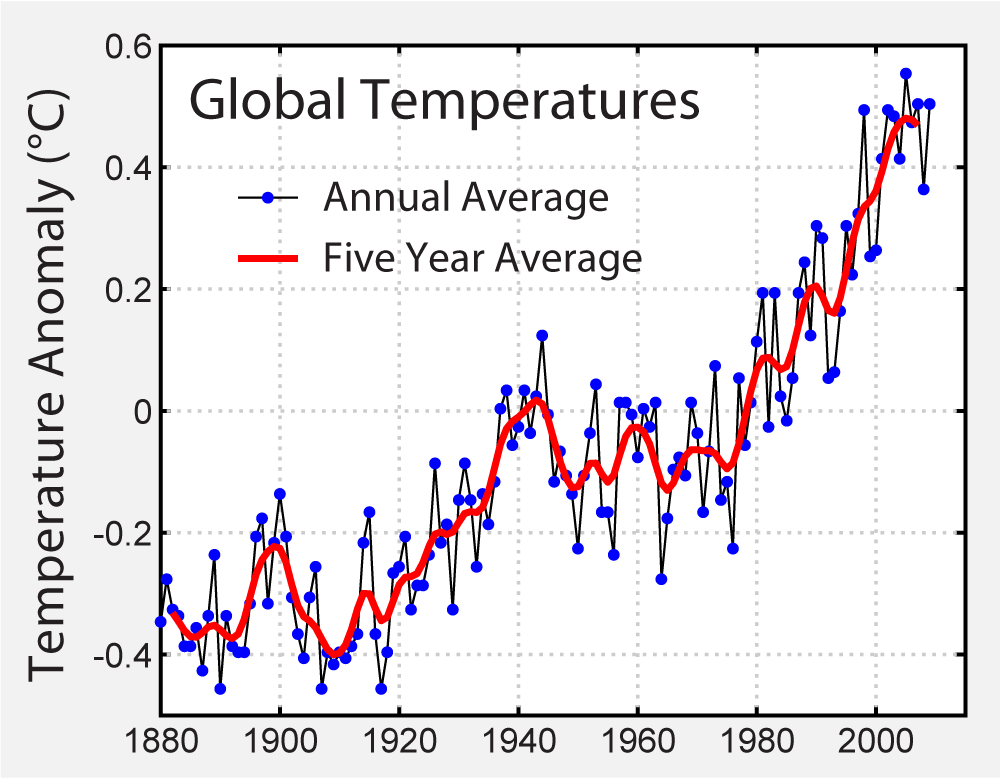
If you have a problem with (1) or (2), then reading further may only be amusing at best. However, I think that many people have already bought into these two ideas and the rest of my explanation assumes that they are true.
So, you might ask, "If carbon dioxide emissions are contributing to global warming, then shouldn't we reduce them?" My answer is: No. We should cease all industrial emissions of carbon dioxide and other greenhouse gases and we should do it yesterday and even if we could do this, we would still be facing a warming Earth.
Why? The answer has to do with how long carbon dioxide hangs around in the atmosphere. This graph, which I'm having some trouble embedding, shows some recent data on atmospheric carbon dioxide. One of the key elements on display here is the "sawtooth" pattern that we see. This pattern correlates to the annual temperature cycle of the Northern Hemisphere (most of us know this cycle as the change of seasons). The Northern Hemisphere contains a "green belt" where the majority of vegetation on Earth is located. The level of atmospheric carbon dioxide declines into the autumn, but as vegetation decreases in the cooler months it begins to rise again.
We can see then that the Earth has an annual carbon dioxide uptake mechanism, but it also has long-term uptake mechanisms, one such example being the Earth's oceans (a consequence of which is increased acidity). However, we have been putting more and more carbon dioxide into the atmosphere, more than natural cycles are equipped to cope with in the near-term. If we accept that carbon dioxide is to blame for global warming and we accept that we are responsible for putting it there, then it makes sense not just to reduce the wait at which we put it there, but to stop putting it there altogether.
It makes even more sense once we understand that carbon dioxide has an "atmospheric half-life" of somewhere between 20 and 50 years. I put that phrase in quotes because it's not quite the same thing as a radioactive half-life, but there are good measures out there that indicate this time frame. What this means is that even if all anthropogenic carbon dioxide emissions were halted today, we would still be experiencing a warming effect until the Earth has had time to correct, which could take as much as a century.
In this respect, marginal, near-term reductions in the "carbon footprints" of individuals or firms fall laughably short of action that will significantly impact our climate future. "Cap and trade" measures that do little to get us close to zero emissions are little better than feel-good nonsense like "Earth Hour". The fact of the matter is that climate change is now a reality. Of course, we should take emissions down to zero, but even if we could do so instantly, we would still be left to reckon with a warming global climate.
The question we should be asking ourselves is not, "How can I reduce my carbon footprint?", but rather, "How can I prepare for a hotter Earth?"
We've entered an era where we face a new breed of problem, climate change being one example. Atmospheric carbon dioxide levels are not a local phenomenon. As I hope I have illustrated, they also aren't really a near-term concern. We've let that genie out of the bottle and will now have to face his wrath. We're talking about a problem of mind-boggling scope: It is a problem that must be solved by people who did not create it for people who they will never know, in place or in time. It requires an entirely new way of thinking about oneself and one's place in the world. Initiatives such as "Earth Hour" are easily dismissed as puerile, but "cap and trade" measures seem to be passing the smell test. This leaves me with little optimism that we've really come to grips with the nature of this problem.
Hopefully, we can not only learn to deal with a changing climate in our time, but also bring ourselves to do what those before us did not: Leave those yet to be born with a world in better condition than we received it.

Comments
interesting post. let me just start off by saying i feel way undereducated on this topic, so maybe it's just ignorance, but i am a bit confused: Just because the wheels of a hotter planet are in motion and even an immediate cessation to all carbon emissions wouldn't be enough to stop it, we should scoff and dismiss any initiatives that have as their goal reducing our carbon footprint???
This seems a bit silly.
To make the analogy to our current economic crisis, I believe overall debt levels have reached a point that no matter what we do we will have to undergo a painful period of retrenchment, but that still doesn't mean we should scoff at ideas that encourage more responsible consumption patterns or attempts to reduce our deficits.
i understand that many scientists feel this is one gear that once set in motion will be hard if not impossible to stop, but at some point that atmospheric half life of which you speak will kick in, and we will begin reaping the benefits of our more earth-friendly lifestyles, right?
i do, however, think you're right if your point is that perhaps we should spend at least as much of our focus, time and money on possible technological or practical responses to a warmer planet (and not so much on trying to stop it from happening, which may be a fait accompli).
by Deadman on Mon, 04/06/2009 - 8:48pm
There seems to be a widely held notion that global warming is something that we can stop and that measures like "cap and trade" will help us do this. The point of my post is that reducing carbon emissions seems to understand the role of carbon dioxide in the warming of the planet, but doesn't really understand it at all. If you buy the science, then you know we've already bought the climate change.
Yes, I scoff freely at feel-good measures that allow us to maintain such a blatant misunderstanding of the problem. Does marginally reducing carbon emissions hurt? It does when it enables us in believing that we're addressing the problem (or that the problem is even still solvable). This doesn't even begin to get into more of the details, such as the power grid infrastructure that is responsible for the majority of carbon emissions. We can make marginal reductions in our power consumption, but most of us simply can't opt out of this infrastructure. Meanwhile, the coal still burns.
Will we one day reap the benefits? Only if we eliminate the anthropogenic carbon emissions of post-industrial societies. Even then, it won't be we, but they who follow us. Is that a good reason to take action? I think it is, but marginal reductions in emissions will not serve future generations much better than they will serve us.
Not to mention that there are plenty of good reasons to stop burning fossil fuels aside from global warming. Petrochemicals are extremely valuable and necessary to modern standards of health as components of food production and chemical inputs for materials like plastic, which is practically invaluable in the field of medicine. While there are alternatives for transportation, we don't have good alternatives for these purposes.
But, as I said in the original post, we're talking about problems that demand incredible levels of foresight. Where will the political will necessary to make massive, fundamental changes to energy and transportation infrastructure come from if people believe that A) global warming can be "stopped" and B) weak iniatives like "cap and trade" will get the job done?
by DF on Mon, 04/06/2009 - 9:07pm
This post dovetails nicely with Deadman's "Playing God ..." below. You've seen my proposed solution: massive and rapid global population reduction. That will inevitably happen, one way or the other, but we're still in for a century or more of rising temperatures. If so, the loss of New Orleans will seem like nature's warning shot. Think Shanghai, New York, London ... .
"Cap and trade" is not even a baby step toward slowing the process. And the irony is that the problem is a zero-sum game that we could win: Too much solar energy trapped in Earth's atmosphere, because we insist on using the solar energy that has already been trapped in Earth's crust. And it's not like we haven't known for millennia how to capture that energy directly: was the sailing ship really that inefficient relative to the coal-powered steamer? Using modern technology, could we not perfect that earlier concept?
Wind power, wave power, tidal power, lightning power (the big kahuna): it's all around us, hundreds of times the energy we need to power our puny "civilization." We're as technologically advanced as any lifeform ever was, and we can't solve this riddle? I say we're not trying hard enough.
by acanuck on Tue, 04/07/2009 - 3:17am
I agree. There's much room for technological innovation. However, the alternative sources you mention are not able to take a big enough bite out of energy infrastructure and transportation at present. Replacing coal is a big deal. Nuclear power can do this right now. Hydrogen fuel cells can be used to store this energy so that we can power our automobiles off of the grid. These technologies exist today and, most importantly, they're actually capable of generating the levels of power necessary and produce zero emissions.
Obama caught some shit from lefties for not utterly condemning nuclear power. I was glad he didn't. I think we'll need it if we're really serious about going to zero.
Solar should be the goal. We should be investing heavily in a goal of highly efficient solar converters and battery technology. Hydrogen is one possible option for storage, but there are others.
Isaac Asimov once proposed that the world get involved in a space exploration program as a way to unite the globe. What if we developed a global satellite network for capturing and relaying solar energy? There's promise in microwave transmission technology.
The options are there, but they require action that is far bolder and more serious than those we're currently engaged in.
by DF on Tue, 04/07/2009 - 1:41pm
I'm not a big fan of nuclear, which in its own way is far dirtier than coal. But maybe it can be part of the short-term mix. Fusion, of course, is the holy grail. Clean, limitless, and the ideal replacement for existing power plants.
Fusion aside, solar is indeed the goal. Basically, apart from nuclear, tidal and geothermal, ALL energy is solar; it's just the storage medium that varies -- photons, plants, coal, oil, wind, waves, rivers, human beings and other animals. We've tapped all of them with varying degrees of efficiency, but we can do better.
My rule of thumb: the simpler, cheaper, more passive and lower-tech the better. Like the systems of rooftop black pipes people use to heat their pools, at zero energy cost. Forget the microwave satellites. To make a dent, the technology ideally has to spread worldwide, and be reproducible on a small-scale, local level.
For that, we need to refocus some of our highest-tech brains on the problem. Like, say, designing wave-powered systems that can be built from floating oil drums to provide reverse-osmosis desalination to entire coastal villages. (I have no idea how this could be done, but someone should be trying to figure it out.)
Anyway, that's the mix: fusion where power grids already exist, and innovative solar capture where they do not. Oh, and cut Earth's population in half.
by acanuck on Tue, 04/07/2009 - 3:35pm
The problem is that we don't have fusion. Fissable materials can be recycled.
The big deal is this: No combination of currently available renewable/alternative energy sources adds up to enough power output to replace coal. Nuclear power is the only existing technology that can do this. If we're serious about eliminating emissions of carbon dioxide, coal has to go. Your rule of thumb sounds nice, but we don't have the luxury of waiting for those perfect solutions.
As far as population goes, even if you could halve the Earth's population right now, how would you keep it stable?
by DF on Tue, 04/07/2009 - 6:56pm
We agree coal has to go. As for "currently available," it surely takes longer to build a new nuclear plant than to set up a string of wind farms and solar collector arrays. But nuclear will be part of the mix.
China's "one couple, one child" policy is pretty effective, though we in the West wouldn't stand for compulsory abortions and the population crunch will have to get much worse before an international consensus begins to emerge.
by acanuck on Tue, 04/07/2009 - 7:38pm
Getting the job done fast is a matter of resources. Neither wind or solar can currently supply the amount of power needed. So, even if you're correct that a wind or solar farm could be deployed faster, it's really neither here nor there. Those technolgies don't currently meet our power needs. The other issue here is localization and intermittent supply. Nuclear power plants can be built anywhere and can produce power 24/7. The same can't be said for wind and solar.
Heh.. it's kind of funny to call China's policy "pretty effective", given that China is one of the most populous nations on the planet. If the only way to stabilize the human population is fiat, then I don't have much hope for a human solution to this problem.
by DF on Tue, 04/07/2009 - 8:02pm
Wow, this is incredible. Say you're in a sports car with a top speed of 200 mph and you've been accelerating, your foot on the gas pedal. You're now at 100 mph and the road is getting twisty. You discover your brakes are out. If you follow DF's advice, you'd push down harder on the gas pedal and hope that you can figure out how to be a good enough driver to outwit physics as you careen around hairpin turns at 190 mph, instead of taking your foot off the gas.
It's true that without brakes it will take a while for the car to come to a safe stop, and you've got a hairraising experience before you, but continuing to accelerate would be suicidal.
by Brad Johnson (not verified) on Tue, 04/07/2009 - 8:44am
What's incredible is that you've provided a perfect example of the kind of mentality I'm addressing. If you'd really read and understood what I wrote, you wouldn't sound so foolish. I never suggested speeding up. Your set thinks we can slow down to 98mph and make it. It's incredibly funny to me that you even went so far as to write "outwit physics". That's exactly what people seem to think they can do!
But we can't. Physics tells us how the greenhouse effect works. It also tells us that carbon hangs out in the atmosphere for quite some time after we put it there. Those who think we can stop global warming by reducing carbon levels back to some 1990s level don't really believe what science is telling us or, at best, only believe about half of it.
If global warming is anthropogenic, then we can conclude that we've already put too much carbon into the atmosphere. The first such indications of this trend date back to the 1980s, yet we think that 1990s levels of carbon emissions will somehow save us? This is tantamount to insanity. Again, if this is what you think, then you don't really believe what science is telling us.
As for how you somehow got that I think we should increase carbon emissions out of what I wrote, I have no clue.
by DF on Tue, 04/07/2009 - 1:32pm
Just saw this - found it interesting. wonder what your take is on it, DF (and others).
http://news.yahoo.com/s/ap/20090409/ap_on_sc/sci_obama_science_adviser
by Deadman on Thu, 04/09/2009 - 10:44am
This is pretty radical stuff. Obviously, it's never been tried before. I've seen similar proposals along the lines of sequestering carbon. One such suggestion involves pumping it to the bottom of the ocean. The idea is that the immense pressure would freeze it. Water has some unique properties, probably the most significant of which is that it expands when it freezes. Air gets trapped in the spaces between the frozen water molecules, which helps it to float. This isn't the case with carbon dioxide, so this would help keep the frozen gas at the bottom of the ocean.
Of course, there are possible side effects for this approach, too. There's always the risk that the carbon dioxide doesn't all stay frozen and that it leeches off into the ocean, which, as I've mentioned, increases the acidity of sea water. This has dire consequences for the bottom of the marine food chain, as these tiny organisms are vey sensitive to acids. This is already occurring as the ocean absorbs increased levels of carbon dioxide from the atmosphere.
Also, I thought I'd mention that my post is partially inspired by one of my physics professors. His message was clear: Global warming is happening. Making reductions over the next five to ten years down to 1990s levels still leaves us on the uptick! It's not good enough. So the main thing to takeaway here is that we ought to count on climate change. The notion that we can somehow save ourselves by making marginal reductions, especially when those reductions only have the goal of capping emissions back to a point where we were still putting excessive amounts of carbon dioxide into the atmosphere, is false and only seems to partially understand what science is telling us.
I'll also mention that this particular professor isn't entirely convinced that co2 is the lone culprit. The data we have on carbon dioxide correlates very well with the warming trend. The role of carbon dioxide in the greenhouse effect is also well understood. Even so, correlatation does not equal causation. To be clear: He doesn't deny global warming or that anthropogenic carbon dioxide plays a role, possibly even the primary role, but he reserves some skepticism in the absence of more definitive evidence.
However, the idea that anthropogenic carbon dioxide is the primary driving force behind climate change is the whole reason for efforts to reduce it. It seems to be widely accepted now that co2 is the problem and that we put it there. What doesn't seem to be understood is how long it will stay there even if we stopped producing it entirely. To me, this key fact tells us that we have to think about how we will deal with a changing climate in our time and how to elimate, not simply reduce, co2 emissions for future generations.
by DF on Thu, 04/09/2009 - 11:53am
It's somewhat reassuring that Obama's pick for science adviser takes global warming really, really seriously. Holdren doesn't come right out and say so, but he seems to concur with DF (and me) that the baby steps that might be agreed to in this year's Copenhagen round of talks won't make a dent in the problem. Half-measures to cut CO2 emissions aren't enough, and the U.S. Congress won't even buy into half-measures.
So he's already looking for a magic bullet. (I've suggested one: since human activity is the root problem, reduce the number of humans. It will take a full generation to start kicking in, but so would any solution. And nothing rules out trying others simultaneously.) Carbon capture and sequestration has one big drawback for me: they actually require more energy use. Much more efficient to capture that carbon through massive reforestation.
Holdren seems to be thinking in terms of mimicking or enhancing natural processes that already are at play. Specifically, boosting the planet's albedo or reflectivity. This could be kinda crucial because the melting and loss of ice caps and snow cover is pushing Earth in precisely the opposite direction. (Loss of reflective ice leads to more trapped heat, which leads to loss of more ice. At a certain point, we've lost all our coastal cities.)
Faced with an already tough economy and vocal global-warming deniers, I can't see even this administration summoning up the political will to effect real change. Without the U.S. and China on board, this century will see massive climate-caused disruption. Somehow mankind will muddle through, and hopefully learn from our mistakes.
by acanuck on Thu, 04/09/2009 - 3:15pm
I should note that it is nice, even promising, to once again have a President that does not look upon science as a bunch of annoying contradictions of the Bible.
by DF on Thu, 04/09/2009 - 3:50pm
Amen.
by acanuck on Thu, 04/09/2009 - 4:20pm
I want to make my stand early on - pumping CO2 into the bottom of the ocean and "fertilzing" the ocean are two of the worst ideas I have heard in a long time.
Multiples worse than Iraq.
by elliottness on Tue, 04/21/2009 - 12:41am
I can think about this topic till the horses come home and only come up with the same answer. Too late and it serves us right.
by Jock Maccrea (not verified) on Sun, 04/12/2009 - 1:49pm
Genghis - The only truly effective and efficient way to address the global heating catastrophe is to tax the consumption of all carbon based fuels at a very high level and then to keep raising the tax. I discussed this in a post at this site some time ago, http://dagblog.com/business/bail-or-not-bail-301, that excited a lively discussion with nobody agreeing with me. It is interesting that since that post, a number of commentators, including the Washington Post editorial page, http://www.washingtonpost.com/wp-dyn/content/article/2009/03/23/AR2009032302024.html, and Thomas Friedman, http://www.nytimes.com/2009/04/12/opinion/12friedman.html?_r=1&ref=opinion, have agreed that a consumption tax on carbon should at least be considered as one of the few options available to help us preserve what biodiversity we have left.
by HSG on Sun, 04/12/2009 - 11:31pm
Just to clarify, none of us disagreed about raising the gas tax, but you were advocating an immediate $5/gallon tax, which would be the hammer blow that would put our already staggering economy into a coma. Raise it, but raise it slowly.
And DF's point in this post is that whether you put enact a $5/gallon tax today or over 5 years, it's still not going to stop global warming.
by Michael Wolraich on Mon, 04/13/2009 - 1:18am
In my comment to which Deadman replied, "none of us disagreed about raising the gas tax," I wrote "[t]he only truly effective and efficient way to address the global heating catastrophe is to tax the consumption of all carbon based fuels at a very high level and then to keep raising the tax."
I did not and do not advocate a small hike in the tax on carbon-based fuels. We need a very significant hike that will make it far more expensive for everyone to use them. DF does not say that a $5 a gallon tax will not slow down global warming. He says that cap and trade will not be effective. It could be if the cap is set very low and it is enforced. But the first will not happen and if it did, then the second wouldn't.
I always wonder why obvious and simple solutions - like a very high tax on carbon-based fuels - are not rapidly embraced. But, then again 1) we pour billions of dollars into drug cartels every year by fighting the "war on drugs," 2) we don't have single-payer health coverage, and 3) we let crazy people buy handguns without background checks at gun shows.
by HSG on Mon, 04/20/2009 - 12:56am
Just to be clear, a heavy fuel tax would be no more effective than cap and trade. My post was about trying to fully understand what science is telling us about the anthropogenic nature of climate change; namely, that we've already punched the ticket.
by DF on Mon, 04/20/2009 - 10:17pm
Are you saying that the rich will build space craft to escape?
by elliottness on Tue, 04/21/2009 - 12:36am
I'd like to subscribe to your newsletter.
by DF on Tue, 04/21/2009 - 2:40am