
Corporate giants once had all-powerful chiefs with domains to match. But activist investors and
technological change are remaking the executive suite.
MURDER, POLITICS, AND THE END OF THE JAZZ AGE
by Michael Wolraich

Corporate giants once had all-powerful chiefs with domains to match. But activist investors and
technological change are remaking the executive suite.
Part of Washington Post article by Dan Balz, "Trump’s contradictory coalition roils elections in Virginia, Georgia" June 17:
[....] As these contests unfold, Emily Ekins of the Cato Institute has provided a timely typology of Trump voters and, by implication, the Republican Party of 2017. Her work is one of several reports produced by the Democracy Fund Voter Study Group, which has brought together analysts from across the political spectrum to design and analyze survey research conducted by the online polling firm YouGov.
Elkins puts Trump voters into five groups: American Preservationists, Staunch Conservatives, Free Marketeers, Anti-Elites and the Disengaged (a relatively small group). Her takeaways are instructive and, for Republican leaders, challenging. She says there is “no such thing as one kind of Trump voter who voted for him for one single reason.” Trump voters hold “very different views on a wide variety of issues,” from immigration to national identity and race to trade and economics.
There are many traditional Republicans in the Trump coalition. He wouldn’t have won without them. But it was other voters who were attracted to his messages on race, religion, immigration and national identity that have left the Republicans in the state they are in. A look at just two of the five groups — the American Preservationists and the Staunch Conservatives — helps explain why navigating can be difficult for any Republican aspirant or elected official.
Elkins describes both as core Trump constituencies. The American Preservationists “lean economically progressive and embrace a nativist conception of American identity, take nativist stances on immigration and believe the system is biased against them.” Staunch Conservatives are “conventionally conservative” and distinct from Trump in that way. “They prefer less government intervention in the economy, support moral traditionalism and do not fear a rigged system,” [....]
MORE @ LINK
Special Feature story by Nelson D. Schwartz @ NYTimes Business Day, June 17
Corporate giants once had all-powerful chiefs with domains to match. But activist investors and
technological change are remaking the executive suite.
FAIRFIELD, Conn. — [....]
G.E. moved out of this sprawling Skidmore, Owings & Merrill-designed emblem of 1970s corporate modernism in favor of smaller, humbler digs in downtown Boston last year. And last week, Mr. Immelt unexpectedly announced plans to retire after 16 years in the top job, amid a sagging stock price and pressure from activist investors.
General Electric is just the latest storied name in corporate America to show its leader the door. Ford’s chief executive, Mark Fields, had been in the job for less than three years when he was fired in late May. Two weeks earlier, Mario Longhi of U.S. Steel abruptly stepped down.
With these departures, the American era of the baronial chief executive, sitting atop an industrial dominion with all the attendant privileges, is drawing to a close.
It is one consequence of a transformed economic landscape in which many of the mega-corporations that defined 20th-century commercial life are confronting a host of new business and technological challenges. These changes — in corporate leadership, on boards and across Wall Street — are recasting the very idea of industry in America.
“The C.E.O. with a big office, a tenure of 10 or 20 years, in a suit and tie, is becoming a thing of the past,” said Vijay Govindarajan, who served as G.E.’s chief innovation consultant in 2008 and 2009 and now teaches at Dartmouth’s Tuck School of Business.
Mr. Immelt’s exit from G.E. is particularly telling, given the company’s reputation as a training ground for the future chief executives of other companies [....]
HAVANA (AP) — President Donald Trump’s announcement that he’s “cancelling” his predecessor’s policy toward Cuba is a good deal less than meets the ear.
Trump’s move, announced Friday in Miami, actually leaves in place most of the important elements of President Barack Obama’s moves to open relations with the island.
And while his policy has the stated aim of helping the country’s nascent private sector, it contains a measure that could damage thousands of small-business people who host, feed and transport independent American travelers to Cuba [....]
By Caitlin MacNeal @ TalkingPointsMemo.com, June 17
The U.S. Commission on Civil Rights, a watchdog agency in the federal government that monitors civil rights law enforcement, announced on Friday that it would launch a two-year assessment of the executive branch.
The commission warned that budget cuts proposed by President Donald Trump’s administration could lead to a “dangerous reduction” in civil rights law enforcement.
“The Commission, by majority vote, expresses concern with the Administration’s proposed budget cuts to and planned staff losses in numerous programs and civil rights offices across the federal government that enforce our nation’s federal civil rights laws,” the commission said in a statement [....]
The assessment will look at whether the federal government will be able to properly enforce civil rights law with budget cuts and whether the “management practices” in place in the federal government are sufficient. The commission cited specific actions from federal government agencies that caused concern. The commission noted that the Justice Department decided to place Immigrations and Customs Enforcement in courthouses, arguing it could be a “dangerous impediment to access to justice .” [....]
By David D. Kirkpatrick @ NYTimes.com, June 17
LONDON — President Trump has done business with royals from Saudi Arabia for at least 20 years, since he sold the Plaza Hotel to a partnership formed by a Saudi prince. Mr. Trump has earned millions of dollars from the United Arab Emirates for putting his name on a golf course, with a second soon to open.
He has never entered the booming market in neighboring Qatar, however, despite years of trying.
Now a feud has broken out among these three crucial American allies, and Mr. Trump has thrown his weight firmly behind the two countries where he has business ties, raising new concerns about the appearance of a conflict between his public role and his financial incentives [....]
By Jose A. DelReal and Scott Clement @ WashingtonPost.com, June 17.
A Washington Post-Kaiser Family Foundation survey found rural Americans are apprehensive about the nation’s rapidly changing demographics, fear that Christianity is under siege and believe that the government cares more about city dwellers. But the disagreements between rural and urban America ultimately center on fairness: Who wins and who loses in the new American economy?
America’s cultural divide runs deep. While rural and urban Americans share some economic challenges, they frequently diverge on questions of culture and values. On few issues are they more at odds than immigration.
Long-form feature story with lots of sections, photos, graphics, etc. The partners spent a lot of time and money on this, not just another snap poll.
MOSUL, Iraq — In the last square mile of Islamic State territory in this city, terrified families trapped in their basements are bracing for a final ferocious showdown.
As many as 150,000 residents are crammed into Mosul’s Old City, as Islamic State fighters fortify their positions in the warren of narrow streets and alleyways [....]
The punishing eight-month battle for the city has taken place in heavily populated neighborhoods, leaving entire streets in ruins [....]
In the middle of the historic city center lies the Great Mosque of al-Nuri [...] where Islamic State leader Abu Bakr al-Baghdadi declared a caliphate three years ago. The fighters have hunkered down in surrounding alleys — nine or 10 in each, according to another resident who recently fled — and zip around on motorcycles.
Lt. Gen. Stephen Townsend, commander of the U.S.-led coalition backing Iraq’s fight with airstrikes and military advisers, recently described Mosul as the toughest urban warfare he has witnessed, or even read about, during his 34 years of service. But Iraqi and U.S. military officials expect the final push into the Old City to be more brutal still as the militants make a last stand.
Massacres of civilians attempting to leave have deterred many from trying. In the worst incident, more than 100 people were gunned down near the city’s Pepsi factory this month. The militants also confiscate identity cards; some men are scared to leave without them because security forces might suspect they are Islamic State fighters [....]
I heard inklings about this before, but this is an explanation that is truly fascinating about the Russian computer contacts in Trump Tower.
https://teapainusa.wordpress.com/2017/04/03/data-patterns-suggest-trump-...
By Annie Lowrey @ TheAtlantic.com, June 15
This week, the Federal Reserve decided to raise interest rates, a move intended to slow the economy down. It makes some sense. The current spell of growth has lasted for nearly 100 months. The jobless rate is down to 4.3 percent, and less than 2 percent in some metro areas. Wages are increasing, though not by much more than inflation. The monthly jobs numbers continue to look decent. As such, as expected, the Fed raised its benchmark rate by a quarter of a percentage point, from 1 to 1.25 percent.
But there is one main indicator that does not signal an economy getting hot—and it is one that the Fed is supposed to be keeping an eye on just as closely as it keeps an eye on employment. That is inflation. Price increases have proven remarkably, persistently sluggish [....]
This poses a quandary for the Fed, and about the Fed. Why is inflation so low if the economy looks so good, judging by other metrics? And why would the Fed raise rates—cooling the economy off and potentially keeping thousands of workers from joining the labor force, getting a gig, or getting a raise—given that inflation is so low? [....]
The root causes of today’s low rates of price growth might be mostly benign [....]
The announcement is particularly noteworthy, given the nation’s longstanding conservatism—but experts fear it could do little to effect social change.
By Kim Willsher from Paris @ TheGuardian.com. June 15
A French politician and candidate in this Sunday’s parliamentary elections was left unconscious after an altercation with a protester while out campaigning. Nathalie Kosciusko-Morizet, a former government minister who unsuccessfully stood to be mayor of Paris, was approached and insulted by a passerby as she handed out leaflets in a market in the city. When the man, described as middle-aged, grabbed the leaflets and tried to throw them in her face, NKM, as she is known, put her hand up to protect herself, then appeared to lose her balance and fall.
Witnesses said the man, who shouted that she was a “shitty bobo”, a shortened term for a bourgeois-bohemian that is often used as an insult to the city’s wealthy middle-class professionals, ran off into the nearby Métro when he saw her collapse on the ground [.....]
War crimes investigators say US-backed campaign to reclaim Syrian city from Islamic State has led to at least 300 deaths
By Kareem Shaheem in Istanbul for Guardian.com, June 14
UN war crimes investigators have denounced a “staggering loss of civilian life” caused by the US-backed campaign to reclaim Raqqa, the de facto capital of Islamic State.
The independent commission of inquiry tasked with investigating violations of international law, war crimes and crimes against humanity in Syria said the intensification of airstrikes by the US-led coalition had led to the deaths of at least 300 civilians in the city.
The Raqqa operation began last week with a ground assault by the Syrian Democratic Forces (SDF), an umbrella group comprising Kurdish and Arab militiamen armed by the US and supported by coalition airstrikes [....]
By Emmett Berg @ Reuters, June 14
SAN FRANCISCO - A UPS driver opened fire with a handgun inside a United Parcel Service Inc (UPS.N) delivery center in San Francisco on Wednesday, killing three co-workers before fatally shooting himself as police closed in, authorities and company officials said.Two people wounded by gunfire were taken to a hospital. Five other people suffered less serious injuries in a frantic exit from the building, San Francisco police said. The gunshot victims, like the killer, all were UPS drivers, and the attack unfolded as the workers gathered for their daily morning meeting before starting their delivery rounds, said Steve Gaut, head of investor relations at UPS [....]
Is Alibaba's founder playing with fire or toeing the line?
By Lulu Yilun Chen @ Bloomberg Technology, June 14
[....] At Alibaba's annual investor day, China's richest man outlined a vision where the company he founded could become the world's fifth-biggest economy by 2036, trailing only the U.S., China, Europe and Japan. Let's just say most entrepreneurs in China wouldn't make that comparison [....]
n Hangzhou, in front of thousands of global investors, Ma planted the flag and claimed that his company would one day become one of the world's most powerful economies by serving 2 billion people and helping 10 million small businesses trade freely on the web. On the face of it, the declaration encapsulates the libertarian dream of empowering individuals and transcending borders. Ma has spent years cultivating an image of a rebel fighting the system, knocking down walls protecting state-owned enterprises and becoming a billionaire in the process.
Yet on closer examination, it's clear that none of Ma's rhetoric ignored the groundwork that has already been laid out by Beijing, whether it's China expanding its footprint in Africa, exploring the ocean frontier in Southeast Asia, or revitalizing the once-famous Silk Road. When Xi Jinping was in Davos talking up global trade, Ma was quick to call (again) for his web-based version of the World Trade Organization [....]
By Masha Gessen @ NY Review Daily, June 14
The new face of Russian protest is barely pubescent. Reports from the June 12 demonstrations, which brought hundreds and sometimes thousands of people into the streets of just about every Russian city, feature teenagers: a boy in shorts being tackled by police in riot gear, a girl charging a police line, and a paddy wagon full of adolescents. One Russian Facebook user posted a photograph of the teenagers in the paddy wagon with the caption, “Russia has a future.” He posited that “every mass arrest of young people strengthens youth protest,” which, in turn, is sure to bring about the end of the regime.
There is a feverish tone to Russian blog posts in the aftermath of Monday’s protests, a sense of hope struggling to defy fear. Without a doubt, Monday’s protests—often in open defiance of Russian authorities, who in many cities refused to give permits to hold them—were the most geographically widespread in all of Russian history [....]
By Chad Bray @ DealBook @ nytimes.com, June 13
LONDON — Three former traders in Britain have agreed to travel to the United States to face criminal charges that they were part of a conspiracy to rig foreign currency markets.
The criminal case represents a stark contrast in the approach that British and United States authorities have taken in a long-running series of inquiries into whether bankers had colluded to manipulate the trading of currencies, an area that is lightly regulated.
In the last three years, some of the world’s biggest banks, including Barclays, Citigroup, JPMorgan Chase and the Royal Bank of Scotland, have agreed to pay billions in civil penalties in the inquiries and some banks have pleaded guilty to criminal charges in the United States. Several traders also have lost their jobs as a result.
But only United States authorities have brought criminal charges against any individuals. British authorities closed their investigation without any criminal charges last year [....]
The below is from the slideshow at the Washington Post story link. There are many photo groupings of it out there; if you don't want to use a WaPo click on it, take a minute to find one and check out what happened. This wasn't just any old fire, it was hell.
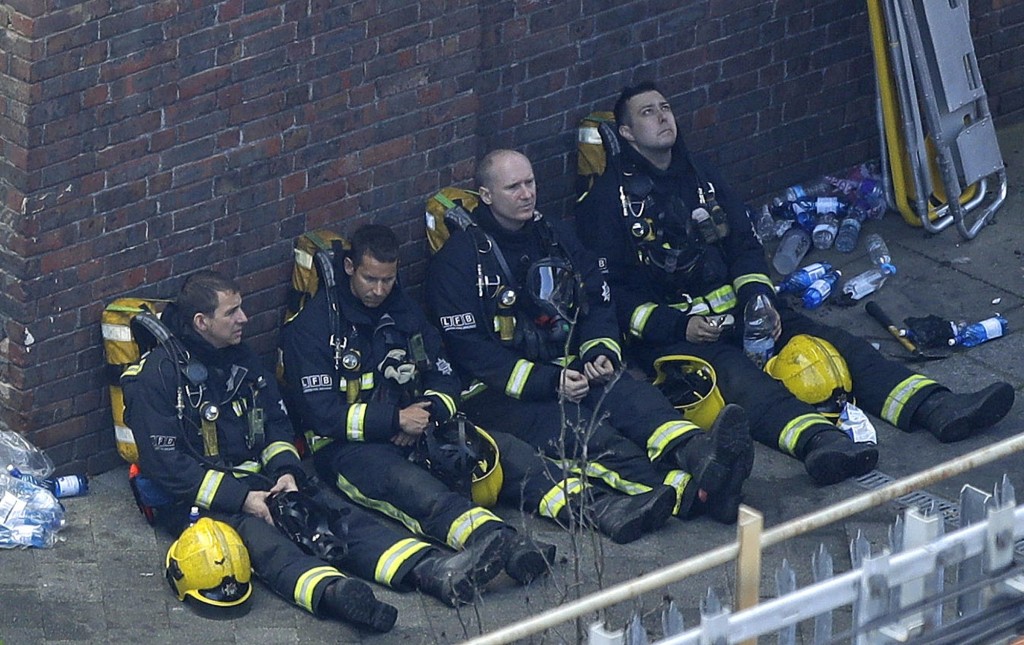
@ WashingtonPost.com, June 14, 6:12 pm
[....] The vote of 97 to 2 is a sharp rebuke to President Trump’s posture on Russia and his resistance to the intelligence community’s assessment that the country was behind efforts to influence the election he won.
The two senators who voted against the measure were Republicans Rand Paul (Ky.) and Mike Lee (Utah).[....]
By Ellen Nakashima @ WashingtonPost.com, June 14
The National Security Agency has linked the North Korean government to the creation of the WannaCry computer worm that affected more than 300,000 people in some 150 countries last month, according to U.S. intelligence officials.
The assessment, which was issued internally last week and has not been made public, is based on an analysis of tactics, techniques and targets that point with “moderate confidence” to North Korea’s spy agency, the Reconnaissance General Bureau, according to an individual familiar with the report.
The assessment states that “cyber actors” suspected to be “sponsored by” the RGB were behind two versions of WannaCry, a worm that was built around an NSA hacking tool that had been obtained and posted online last year by an anonymous group calling itself the Shadow Brokers [....]
The move by Robert S. Mueller III to investigate President Trump’s own conduct marks a major turning point in the nearly year-old FBI investigation.
By Devlin Barrett, Adam Entous, Ellen Nakashima & Sari Horwitz @ WashingtonPost.com, 2 hours ago
The special counsel overseeing the investigation into Russia’s role in the 2016 election is interviewing senior intelligence officials as part of a widening probe that now includes an examination of whether President Trump attempted to obstruct justice, officials said.
The move by special counsel Robert S. Mueller III to investigate Trump’s conduct marks a major turning point in the nearly year-old FBI investigation, which until recently focused on Russian meddling during the presidential campaign and on whether there was any coordination between the Trump campaign and the Kremlin. Investigators have also been looking for any evidence of possible financial crimes among Trump associates, officials said [....]
By Jeff Asher and Rob Arthur @ The Upshot blog @ NYTimes.com, June 13
I read yesterday and found it intriguing that the authors conclude it is not ready for primetime yet, should still be "buyer beware" but promising...decided to go to my browser history and post it now because today's news put guns back on the news radar:
Gun violence in Chicago has surged since late 2015, and much of the news media attention on how the city plans to address this problem has focused on the Strategic Subject List, or S.S.L.
The list is made by an algorithm that tries to predict who is most likely to be involved in a shooting, either as perpetrator or victim. The algorithm is not public, but the city has now placed a version of the list — without names — online through its open data portal, making it possible for the first time to see how Chicago evaluates risk.
We analyzed that information and found that the assigned risk scores — and what characteristics go into them — are sometimes at odds with the Chicago Police Department’s public statements and cut against some common perceptions [....
Last week, Lee Camp, an acerbic left-wing comic, dedicated six minutes of his topical TV show, “Redacted Tonight,” to the discredited conspiracy theory that it wasn’t Russian hackers who leaked emails during the presidential election but Seth Rich, the Democratic National Committee staff member killed in a botched robbery.