wordles are more than games
The summer winds on, we've a new Supreme Court Justice, and in a
week or so I'm going to imitate Chaucer, though he did his bit in the
spring:. Off I go on pilgrimage to England... the country
separated from the United States by a common language. I'm off to
see an old friend of mine whom I met when he worked for the Historic
Buildings Division of the Greater London Council in the days
before Margaret Thatcher's Tories abolished Greater London. (How
sad to see the noble building reduced to housing an aquarium--but I
digress, this post is going to do that a lot). Why do people
visit Merry Olde England? Cultural or Heritage Tourism is a big
draw...the Monarchy survives at least partly because it provides a sort
of cachet attractive to those who want their pomp circumstantial.
People who say
they hate history behave as if they love
history. In the United States, the National Park Service is
a major employer for Historians. One can specialize in Heritage Tourism and Heritage Tourism is touted (bad
word, but I'm stuck with it) as a money-maker. Why then do
history courses wind up on the take-it-because-it-is-good-for-you list? The list
which is the kiss of death? I suppose it is because
academics can make anything dull if they work at it hard enough.
It's a craft. It's a gift. But here's a secret: we're
not the best at making things dull and incomprehensible. We're
actually far more popularizers than people give us credit for being,
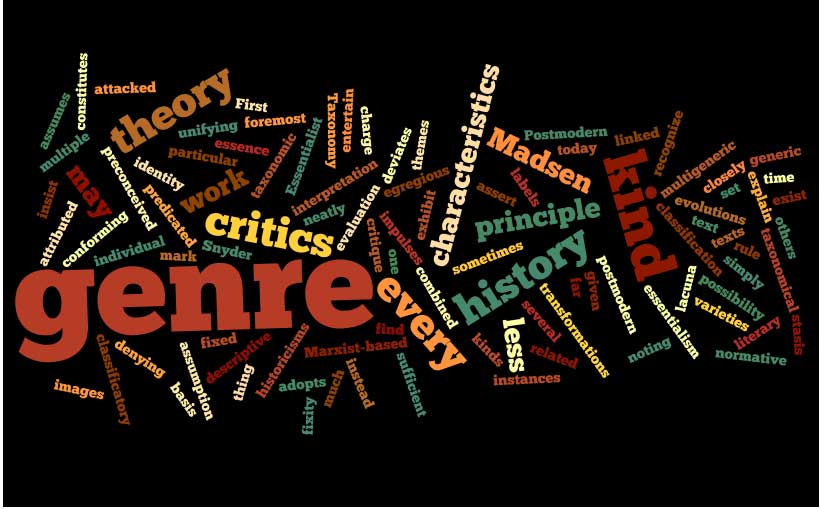
The postmodern critique of genre
adopts several themes. First and
foremost, denying the assumption of generic "essence" or a fixed
identity for any given genre, critics have attacked classificatory
impulses of descriptive genre theory, noting that, as a normative rule,
"every work deviates from any particular set of characteristics that
may be attributed to its kind" (Snyder, 1). A related charge is that,
far from conforming neatly to taxonomic labels, most texts exhibit
characteristics of more than one kind of genre and sometimes of
multiple kinds: "Essentialist genre theory assumes that a preconceived
unifying principle is a sufficient basis for interpretation,
classification, and evaluation, and this kind of genre theory simply
does not entertain the possibility that there may exist such a thing as
a multigeneric text" (Madsen, 8). Taxonomy as a principle is predicated
on images of fixity and stasis; critics today insist that a taxonomical
essentialism cannot recognize - much less explain - the evolutions and
transformations that mark the history of every genre. Postmodern
critics, linked closely to the varieties of Marxist-based literary
historicisms, find this lacuna the most egregious of all and assert
instead that "over time every work combined with all others of more or
less the same kind constitutes the history of the genre: the genre is
its history of individual instances" (Madsen, 9).
I started this post because I wanted to introduce people to the glories
of Wordles. As the inventor of this gadget describes "Wordle is a
toy for generating "word clouds" from text that you provide. The clouds
give greater prominence to words that appear more frequently in the
source text." I think he's too modest. This may be fun, but
it's more than a toy. The word clouds are significant.
Try Wordle-ing some of the text from TPM Blogs, or, for that matter,
anything "newsworthy" or "Political".
Behind this text lies a skirmish about General Education in which
I've been involved this summer. The serious side of the
issue is the tendency of some academics (hopefully not me) to
practice populism in reverse. If I can make language as opaque as
possible and simultaneously create a gate through which only those
blessed with control of the language can pass, I can control the
discourse, and become a member of the privileged elite. Beggar
whether anyone outside cares one way or the other. May I be given
fifty lashes with a wet noodle if I ever use a phrase like "find this
lacuna the most egregious of all" in public without quotes.