The Occupy movement got rolling in New York on Sept. 17 with an inchoate and broad coalition of people attempting to “Occupy Wall Street” in order to push back against the rampant capitalism that many feel is overwhelming/undermining American politics and American society itself.
As many have noted, Occupy Wall Street didn't get noticed by the press until there was violence against protestors by the police. During an attempted expansion into a neighboring park, Occupy Boston linked arms to try to hold off an overwhelming force of police. There have been scattered other incidents around the US, but Andrew, who I chatted with on Day Three, and was on the Security Committee of Occupy Baltimore (OB), said that the Baltimore police had been cool.
KAI RYSSDAL: David Frum has been a regular commentator for this program for years, offering the voice of the political right against Robert Reich and the views of the political left. It's been, for the most part, a mutually agreeable relationship. We alienate different segments of our audience every other Wednesday.
[James Fallows] On April 13 of this year, a Wednesday, my wife got up later than usual and didn’t check her e‑mail until around 8:30 a.m. The previous night, she had put her computer to “sleep,” rather than shutting it down. When she opened it that morning to the Gmail account that had been her main communications center for more than six years, it seemed to be responding very slowly and jerkily. She hadn’t fully restarted the computer in several days, and thought that was the problem. So she closed all programs, rebooted the machine, and went off to make coffee and have some breakfast.
... “The Way Forward: Moving From the Post-Bubble, Post-Bust Economy to Renewed Growth and Competitiveness.” ... was commissioned by the New America Foundation, which hoped that it might “re-center the political debate to better reflect the country’s deep economic problems,” ... Its authors are Daniel Alpert, a managing partner of Westwood Capital; Robert Hockett, a professor of financial law at Cornell and a consultant to the New York Federal Reserve; and Nouriel Roubini, who is, well, Nouriel Roubini, whose consistently bearish views have been consistently right.
The Baltimore action was impressive in both its energy and organization. One key ingredient to this success is their location at the McKeldin Fountain, which is simultaneously located in the heart of the downtown area, and wedged between moron attractions like the Hard Rock Cafe and the financial district. As a result, they have way more foot traffic than Boston or DC, where folks almost have to go out of their way to check the goings on up close. As a result, Baltimore has recruited a number of passers-by, while repulsing blond-haired young Republicans en route to Dick's Last Resort.
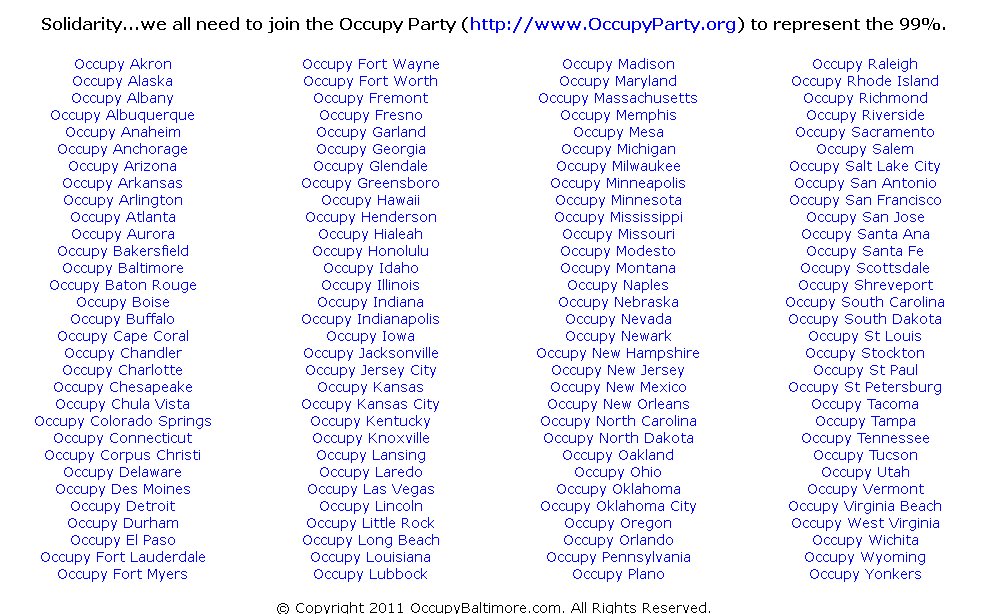
I just googled Occupy Baltimore, found wwwdotOccupyBaltimoredotcom, and thought, hey they're making progress. But at the bottom of the page, above links to 124 other Occupy domain links, is a link to Occupy Party. If you followed the discussion in Genghis' latest article, Lost in Liberty Square, he commented:
The key difference between the standard "liftback" Prius and the PHV model that was the [main] focus of the event held on September 16, 2011 in Richmond, California, apart from the price that is, is the plug-in model's ability to run up to 15 miles as an electric car, after which the Hybrid Synergy Drive takes over. That's 15 percent better than the earlier demonstrators. In EV Mode, Toyota's estimates it delivers the equivalent of 89 miles per gallon. In hybrid mode that drops back to a still Volt-beating 49 mpg average.
By Donal on Thu, 10/06/2011 - 1:41pm | Social Justice
Over lunch hour, I walked over to see what was happening at Occupy Baltimore (OB). I first noticed a row of galvanized steel traffic barriers around the square that had a lot of bicycles locked to them. I recognized some of the bikes from Day One. In the middle of the square was a fellow with a small amp playing guitar and harmonica. But there was no central focus.
[Former Premier] Lougheed opposes the Keystone pipeline, which promises to bring nearly a million barrels of bitumen a day to the Texas refineries, for several economic reasons. To him the export of raw bitumen to the U.S.
In the past year – one of the hottest on record – extreme weather has battered almost every corner of the planet. There have been devastating droughts in China and India, unprecedented floods and wildfires in the United States, and near-record ice melts in the Arctic. Yet the prosperous nations of the world have failed to take action to reduce the risk of climate change, in part because people in prosperous nations think they're invulnerable.
I walked over to see Occupy Baltimore today. First I saw a large group of people doing jumping jacks. That turned out to be Health City. Then I got to McKeldin Square, at the corner of Pratt and Light Streets in view of Inner Harbor. There were maybe fifty people, including a dozen journalists and half a dozen police (poh-leece), three of them on motorcycles. A few dozen onlookers stood around the edges of the small plaza but it seemed clear that they weren't part of it.
No one was doing calisthenics, but a few casually-dressed people were on their knees writing signs on sheets. I felt like saying, "Please don't misspell morons." A camera-toting fellow was interviewing a fellow with a beard, who made it clear that he didn't speak for everyone, but who was the only one speaking. A fellow wearing a LaRouche breadboard was handing out flyers, and a few folk were holding copies of a thin Workers' Week paper. The bearded fellow invited anyone to make a sign.
[Diane Winston] “Whatever Happened to the American Left,” Michael Kazin’s substantial opinion piece in Sunday’s New York Times, delineates two axioms of conventional wisdom: that today’s conservative movement began in the 1970s and that the American left is MIA.


 Update:


 Over lunch hour, I walked over to see what was happening at Occupy Baltimore (OB). I first noticed a row of galvanized steel traffic barriers around the square that had a lot of bicycles locked to them. I recognized some of the bikes from Day One. In the middle of the square was a fellow with a small amp playing guitar and harmonica. But there was no central focus.
