Donal: Is Occupy Over?
Ramona's Piece de la Resistance (Including Pics of Obama, Romney, FDR)
dagblog To Give Away Logoed Hairshirt To Most Effective Lamenter Of Left's Ineptitude
|
Donal: Is Occupy Over? Ramona's Piece de la Resistance (Including Pics of Obama, Romney, FDR) dagblog To Give Away Logoed Hairshirt To Most Effective Lamenter Of Left's Ineptitude |
Read |

Ten days ago, I said good-bye to Indonesia. My last few months there were a bit of a whirlwind, especially my last four weeks. I barely had time to say good-bye and that makes me very sad. My year in Indonesia was one of the best of my life. It sounds ridiculously cheesy to say I found myself again, but it's true. After my mom's long illness and years in the wilderness, I rediscovered my love of adventure, of new experiences, and mostly of not being stuck in a rut. I also discovered a true love of my own language and a love of helping others learn it. [Read more]

Articleman keeps dropping hints that I should give a Southeast Asian expat perspective on what’s happening in Egypt. By dropping hints, I mean that he keeps emailing me and telling me to write a Southeast Asian expat perspective on what’s happening in Egypt. I’ll think about that some more and get back to you.
But first, let me apologize for disappearing right in the middle of a blog series. I’d like to finish the Blowing Smoke book group discussion in the coming weeks. I hope that you’ve all read the outstanding TPM version in the meantime!  [Read more]
ArtAppraiser asked for my thoughts on a New York Times article about the relationships Indonesia is forging with the United States and China. I have to admit I haven't been paying that much attention to politics and economics over here. There isn't much in-depth analysis in the English-language press and my friends are mostly fellow teachers, so we talk more about grammar and culture than geopolitical manuevering. But, for what's it's worth, I do have some thoughts. So, here they are!  [Read more]
You'd think for the kind of money President Obama is spending on travel in Right-Wing Fantasy Land, there would be at least one public event during his time in Indonesia. I mean, it's not like there are occasional attacks of terrorism in a city that is beyond impossible to secure.
Except it is exactly like that. Oh, well. I know somebody who knows somebody who is invited to dinner with the President this evening. Him and a few hundred other more important expats. Not that I'm bitter. But for $200 million a day, you'd think anybody holding a U.S. passport would be invited. [Read more]
![]()
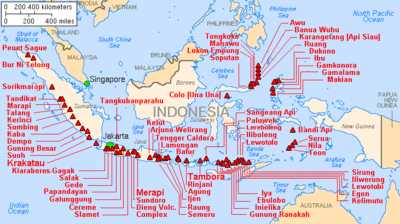
There are, currently, about 500 active volcanoes in the world. If that sounds like a lot, don’t worry. Only 50 of them are in the United States, and most of those are probably in Hawaii. A bit more worrying is the fact that there are about 1,500 potentially active volcanoes around the globe. That’s 2,000 volcanoes that could, at any time, go boom. [Read more]
I didn’t have internet service at my house this week. There was nothing wrong with the service. I paid the bill and magical signals were coming through the cables hanging high up above the street. I say magical because I don’t understand the ins and outs of how I can sit down on my couch in Jakarta and communicate with people all over the world through invisible electrical impulses. What’s more, I don’t really care how it works, just that it does. And when it fails, I get the tiniest bit cranky.  [Read more]

Hi folks! I'm glad to see so many new Dagbloggers. I'm in the middle of an epic holiday but I'm planning on spending a good deal of time in October, catching up on my Dag reading.  [Read more]
Lebaran is this weekend which means I have successfully completed my first Ramadan in a Muslim country. I wasn't affected much. My area of the city has almost as many Christians as Muslims, so the restaurants were still crowded at lunch time. I was more careful about eating, and drinking alcohol, outside during daylight hours and I didn't eat in front of my Muslim co-workers prior to sundown, but other than that, life went on normally. [Read more]

When I came to Indonesia in the middle of January 2010, I came with a few preconceived notions:
1. It was going to be hot;
2. The food was going to be great; and
3. The country had the largest Muslim population in the world. [Read more]
Bukit Lawang is a village in North Sumatra, on the edge of the jungle. The Bohorok River plays a central role in village life, providing a place to wash bodies and clothes, to cool down during sweltering days, and to have a little fun, running smallish rapids on tubes and in rafts. The village exists almost entirely due to tourism. In 1973, two foreigners set up an orangutan rehabilitation center there, which spawned hotels and restaurants and guides to take adventurous tourists into the jungle in hopes of spotting the orangutans up close. [Read more]
There is a report in the Jakarta Post this morning announcing that the city will begin construction on a sewage system next year. The first phase of the project will take almost 10 years and only serve about 10 percent of the city, but it's a start. In 20 years, a projected expansion plan will reach a quarter of the population. [Read more]
On my way to Jakarta, I had a nine hour layover in Seoul, Korea. As I was planning my trip, I considered spending that time sight-seeing or finding a restaurant with some excellent bi bim bop. But then I realized I would be tired and grimy, so then I decided to try to find out if there was any place at the Seoul airport where I could take a shower. I was explaining this idea to a friend who frequently travels to India and she made a suggestion that changed my entire trip. She said, “Why don’t you look for a day-rate hotel?” Whichever hotel maven thought up this idea was a genius. I booked a room in a hotel close to the airport for seven hours. Their van picked me up and brought me back. [Read more]
Perceptive Dagblog readers know the difference between Obama, Romney and Bush:
Obama NYT today: .how President Obama’s thinking about what he once called “a war of necessity” began to radically change less than a year after he took up residency in the White House....The aide told Mr. Obama that he believed military leaders had agreed to the tight schedule to begin withdrawing those troops just 18 months later only because they thought they could persuade an inexperienced president to grant more time if they demanded it. “Well,” Mr. Obama responded that day, “I’m not going to give them more time.”...Mr. Obama concluded in his first year that the Bush-era dream of remaking Afghanistan was a fantasy...
Mitt Romney, Feb. 2012 : LAS VEGAS -- LAS VEGAS -- Republican presidential candidate Mitt Romney on Wednesday night blasted President Obama and his administration for “putting in jeopardy” the nation’s military mission by signaling it hopes to end its combat mission in Afghanistan by the middle of 2013.
Appearing at a campaign rally here shortly after landing in Nevada, Romney said Defense Secretary Leon E. Panetta’s statement Wednesday that U.S. forces would transition from a combat mission in Afghanistan next year “makes absolutely no sense.”....
George W. Bush, from May, 2003: BBC - "We do not know the day of final victory, but we have seen the turning of the tide... Free nations will press on to victory,"
Bush Afghanistan strategy : Gen. Douglas E. Lute, who had spent the last two years of the Bush administration trying to manage the many trade-offs necessary as the Iraq war consumed troop and intelligence resources needed in Afghanistan, arrived with a PowerPoint presentation. The first slide that General Lute threw onto the screen caught the eye of Thomas E. Donilon, later President Obama’s national security adviser. “It said we do not have a strategy in Afghanistan that you can articulate or achieve,” Mr. Donilon recalled three years later. “We had been at war for eight years, and no one could explain the strategy.”
Mitt Romney isn’t very far into the vice presidential selection process. But according to a dedicated band of conspiracy theorists, the pick is all but a lock: Sen. Marco Rubio.
That’s the current thinking among a worldwide collection of activists who are obsessed with the secretive Bilderberg Group, an alternating roster of global power players who loom as large — if not larger — in the online fever swamps of the fringe as the Trilateral Commission or the Council on Foreign Relations.
Read more: http://www.politico.com/news/stories/0512/76518.html#ixzz1vN5egowz
Aristotle and Plato didn’t agree on much, but they were united in identifying wonder as the origin of their profession. As Aristotle said, “It is owing to their wonder that men . . . first began to philosophise.” This idea appeals to scientists, who frequently enlist wonder as a goad to inquiry. “I think everyone in every culture has felt a sense of awe and wonder looking at the sky,” wrote Carl Sagan in 1985, locating in this response the stirrings of a Copernican desire to know who and where we are.
Yet that is not the only direction in which wonder may take us. To Thomas Carlyle, wonder sits at the beginning not of science, but of religion. That is the central tension in forging an alliance of wonder with science: will it make us curious, or induce us to prostrate ourselves in pitiful ignorance? We had better get to grips with this question before we too hastily appropriate wonder to sell science. That is surely what is going on when pictures from the Hubble Space Telescope are (unconsciously?) cropped and coloured to recall the sublime iconography of Romantic landscape painting, or the Human Genome Project is wrapped in biblical rhetoric, or the Large Hadron Collider’s proton-smashing is depicted as “replaying the moment of creation”. The point is not that such things are deceitful or improper, but that if we want to take that path, we should first consider the complex evolution of the relation between science and wonder.
[....]
Pretending that science is performed by people who have undergone a Baconian purification of the emotions only deepens the danger that it will seem alien and odd to outsiders, something carried out by people who do not think as they do. Daston believes that we have inherited a “view of intelligence as neatly detached from emotional, moral and aesthetic impulses, and a related and coeval view of scientific objectivity that brand[s] such impulses as contaminants”. It is easy to understand the historical origins of this attitude: the need to distinguish science from credulous “enthusiasm”, to develop an authoritative voice, to strip away the pretensions of the mystical Renaissance magus who acquired knowledge through personal revelation. We no longer need these defences, however; worse, they become a defensive reflex that exposes scientists to the caricature of the emotionally constipated boffin, hiding within thickets of jargon.
... We’re trying to harness photosynthesis. A key part of photosynthesis is what happens when the sun goes down. Cells convert CO2 into sugar and fat molecules. And they store the fat to burn as energy to get them through the night ... We’re trying to coax our synthetic cells to ... store far more fat than they actually were designed to do, so that we can harness it all as an energy source and use it to create gasoline, diesel fuel, and jet fuel straight from carbon dioxide and sunlight. This would shift the carbon equation so we’re recycling CO2 instead of taking new carbon out of the ground and creating still more CO2. But it has to be done on a massive scale to have any real impact on the amount of CO2 we’re putting into the atmosphere, let alone recovering from the atmosphere.
... We envision facilities the size of San Francisco. And 10 or 15 of those in this country. We need sunlight, seawater, and non-agricultural land, but you need a lot of photons to drive this. You need a lot of surface area of sunlight to do that. It’s a great use for Arizona. Lots of sunlight there.
... If we can’t get some key scientific breakthroughs within the next couple of years, it probably won’t happen in 10 years. So it’s something that’s really dependent on fundamental science. But we’re already able to do things that were once seen as impossible.
... I think the new anti-intellectualism that’s showing up in politics today is a symptom of our not discussing these issues enough. We don’t discuss how our society is now 100 percent dependent on science for its future. We need new scientific breakthroughs—sometimes to overcome the scientific breakthroughs of the past. A hundred years ago oil sounded like a great discovery. You could burn it and run engines off it. I don’t think anybody anticipated that it would actually change the atmosphere of our planet. Because of that we have to come up with new approaches. We just passed the 7 billion population mark. In 12 years, we’re going to reach 8 billion. If we let things run their natural course, we’ll have massive pandemics, people starving. Without science I don’t see much hope for humanity.