Donal: Is Occupy Over?
Ramona's Piece de la Resistance (Including Pics of Obama, Romney, FDR)
dagblog To Give Away Logoed Hairshirt To Most Effective Lamenter Of Left's Ineptitude
|
Donal: Is Occupy Over? Ramona's Piece de la Resistance (Including Pics of Obama, Romney, FDR) dagblog To Give Away Logoed Hairshirt To Most Effective Lamenter Of Left's Ineptitude |
Read |

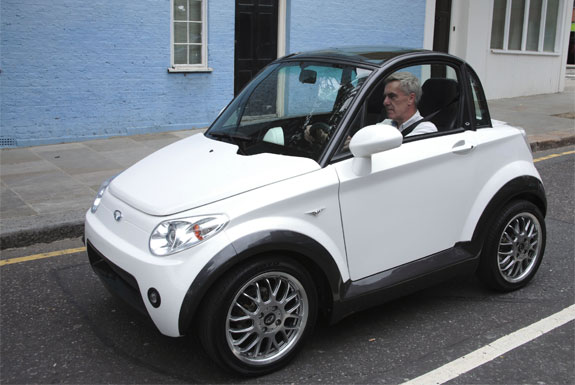
On Saturday, I attended a Solar & Wind Expo, which was held about three stops away on light rail. At the Timonium Fair Grounds stop, there was no sign that anything was happening. I walked past the empty entrance kiosks, and saw a truck with a horse trailer backing up to the mostly empty livestock sheds. I continued past the empty cow palace, and eventually saw some balloons tied to two tiny cars in front of a nondescript concrete block building. The cars were Think City EVs. A small banner announced that the expo was inside.
I was a bit early and when I tried to pay the $10 entry fee with my debit card, one of the cashiers went to a table and pulled a cardswipe machine out of a box. She fiddled with it and asked, "Do you have any cash?" I had eight dollars, so she took that and let me in. That worked out about right because I was supposed to get two dollars off for arriving by light rail. [Read more]

Along with their hybrids and EVs, luxury automakers have been developing prototype e-bikes, like the Audi Wörthersee above. These aren't full-fledged motorcycles, like the Brammo or Zero, but they aren't just bicycles either: [Read more]

Tesla is about to release its Model S sedan. Despite operating at a loss, despite never having turned a profit, despite being the recipient of government loans (which the right wing hates about the Volt), despite its stock price dropping due to perceived competition from the Toyota RAV4 EV, some Wall Street pundits are still bullish on Tesla.
Why? Well it promises decent range:
Tesla: The Time Has Come [Read more]
The Tesla Model S will give you significantly more range than a Nissan LEAF or any other practical all-electric car to date. The Nissan is EPA-certified at 73 miles on average. Tesla claims 160 miles for the base version of the Model S. ...
Tesla will also sell you an alleged 230-mile and a 300-mile version of the Model S. Each step up is $10,000 more.

The public reputation of nuclear power plummeted after the Fukushima meltdowns, but many in the energy sector still see nuclear fission as the only way to keep the lights on and stave off climate change. No private entities, and vanishingly few governments, though, want to spend billions to build new plants, so at least one manufacturer is offering smaller pre-packaged units. Will, The Stars Align for Small Nuclear Reactors? [Read more]
The Westinghouse Electric Company has lined up Ameren, a St. Louis-based electric company, as a partner for its small modular reactor project. Getting a strong indication of commercial interest is critical because the Nuclear Regulatory Commission can review only a few of the many proposed reactor designs and gives priority in the licensing process to those with a stronger chance of getting built.
Some utility analysts have argued that small reactors would be good “drop-in replacements” for 1950s and 1960s-era coal plants that are now being retired, given that that their generating capacity would be about the same.

About a month ago, former GM vice-honcho Bob Lutz gave up on rational argument with Limbaugh, Hannity and the like:
I Give Up On Correcting The Wrong-Headed Right Over The Volt [Read more]
I am, sadly, coming to the conclusion that all the icons of conservatism are (shock, horror!) deliberately not telling the truth!
This saddens me, because, to this writer, conservatism IS fundamental truth. It only damages its inherent credibility with momentarily convenient fiction.
So, Mr. Krauthammer joins the list of right-wing pundits I no longer take seriously. After all, how do I know they’re telling the truth when the subject is one I’m not as familiar with as the Volt?
In, Stop Bashing Electric Cars!, Brian Wynne, president of the Electric Drive Transportation Association, complains about adverse media coverage:
It’s not often that you hear national elected officials and media pundits rooting against a growing American industry — especially when it’s reducing U.S. dependence on imported oil. It’s also unusual for them to argue against job creation, global competitiveness, even against innovation.
Strangely, that’s what’s happening to the U.S. electric vehicle industry.
Particularly striking is how far removed public debate on electric vehicles is from the facts. Our industry is growing fast, adding jobs throughout the supply chain and selling more vehicles and components than ever. The future is bright, but you’d never know it from some of the commentary.
There certainly have been right-wing attacks on the Chevrolet Volt and General Motors—ultimately intended to discredit President Obama. But there have also been straightforward discussions about unflattering facts, such as the still narrow market share of EVs and hybrids, the Tesla Roadster and Fisker Karma battery packs that failed and 'long tailpipes'—the actual environmental impact of manufacturing and driving electric and hybrid vehicles. Encouraging the media to accurately report the pros and cons makes more sense to me than Wynne's plea that the media do his job by promoting the industry. [Read more]

We were driving past the new location of East Coast Gun Sales a few weeks ago, and I told my wife I had been planning to check out the new store. They had been advertising their move to a larger location, with added facilities like a gun range, for over a year. I was thinking it would be interesting to fire off a few rounds with different caliber weapons and see what it felt like. "They went out of business," she said. She didn't know why.
According to the Altoona Mirror, back in 2007, East Coast's owner James Faith, and Michael Kurty, a police officer and firearms instructor, had been demonstrating a rebuilt mini-Gatling gun during a social event at a sportsmen's club. I'm not sure if this was before or after the chicken Kiev. The Gatling had an electrically-powered magazine, which soon jammed. So Faith unplugged the magazine, while Kurty, the firearms instructor, helpfully stood right in the path of the barrel. Because with no electricity, how could a weapon filled with bullets—which contain gunpowder—possibly fire? [Read more]

In, 500MW from half a gram of hydrogen: The hunt for fusion power heats up, ExtremeTech trumpets a potential efficiency breakthrough in magnetic confinement fusion, the type used at ITER: [Read more]
Basically, to keep fusion going you need to sustain a temperature of around 11 million degrees Celsius, which requires a huge amount of electricity. Fusion chambers are usually lined with heat-resistant carbon tiles in an attempt to reduce wastage, but the problem is that protons and neutrons escaping from the fusion reaction hit the wall, cool down, and then bounce back into the reaction, reducing the temperature. Electricity must then be used to increase the temperature back to 11 million Celsius.
The PPPL [Princeton Plasma Physics Lab], led by Bruce Koel, have found that a thin layer of lithium metal (the third element in the Periodic Table) absorbs these protons and neutrons, preventing them from bouncing back into the pot, and thus reducing the power requirement of keeping the fusion reaction going.

I often stop at a gas station/convenience store near Breezewood PA for their chicken tenders and potato wedges. Sometimes I buy gas, too. After the Macondo blowout and Deepwater Horizon spill, they covered up their BP signs with Shell tarps. They eventually got permanent signage, but I wonder what sign will go up next.
Shell’s Lawsuit Against Environmental Organizations Invites Disaster [Read more]
Shell is suing 12 environmental organizations to preempt legal challenges to exploration in the Arctic Ocean. The environmental groups include, among others, the Center for Biological Diversity, the National Audubon Society, Oceana ... and the Sierra Club. Crazy isn’t it, Shell, a $378 billion company, attacking the National Audubon Society? It’s a bully image that can only hurt, and Shell should know better because it’s happened to them over and over again.
I ran across UCSB's Clean Car Calculator in a comment, and while it seems fairly slick, it could be better: [Read more]
CleanCarCalculator.com grew out of a homework assignment for Energy and Resource Productivity, a graduate course at the Bren School of Environmental Science and Management taught by Professor Sangwon Suh. Initially, the assignment asked students to compare two vehicles—one conventional gas engine and one high-efficiency—in terms of their total lifetime costs. This net present value (NPV) calculation unearthed surprising results. Most of the students had anticipated that purchasing a high-efficiency vehicle, such as a Toyota Prius or Chevrolet Volt, would cost more over the lifetime of the vehicle (i.e. that savings from the higher fuel efficiency would not be enough to offset the higher upfront cost of the vehicle). Instead, we were surprised to not only find that established hybrids paid themselves back in fuel savings, but that newly released vehicles, such as the Volt and Leaf, were also extremely affordable.
First, the San Francisco Chronicle sheds light on the Republicans anti-GM, anti-Tesla, anti-anything Obama strategy:
GM, Tesla fight politicization of electric cars [Read more]
GM Chief Executive Officer Dan Akerson has complained about the political atmosphere that surrounds the Volt.
"Sometimes I feel bad for President Obama," he said this month after an appearance at the Commonwealth Club in San Francisco. "This car was designed and committed to well before he was president, and it's called the 'Obamacar.' It's not the Obama car. I'm proud and I'm pleased that he thinks highly of it, but it's all on us. It's not a political issue."
The automaker accused Republicans and the media of hyping claims that the car caught fire during testing, which forced temporary layoffs at the Volt plant in Detroit.
Tesla, which received a $465 million Department of Energy loan, has dropped pursuit of new federal loans, raised private cash and plans in July to start deliveries of its $50,000 S car, claiming it is on its way to the mass car market.
"We applied during the Bush administration, and we were approved under the Obama administration, so as far as we're concerned, we at least had a bipartisan relationship for the loan," said Tesla spokesman Ricardo Reyes. "We got one of first loans and we used it to build the car that is now going into production in a U.S.-based facility. ... I'd like to think we're pretty much a case study on what the loan program was designed to do."
The Infrastructurist blog shut down in January—but not because we have been paying more attention to our aging infrastructure.
Rivers and canals carry an enormous amount of goods through the hinterlands—coal, grain, fuel oil. Water transport is cheaper than railroads, and far cheaper than trucking. Monongahela or "falling banks," was the native American name for one such river, and we have built a series of manmade structures intended to keep it navigable by large vessels. At what is now Pittsburgh, the Mon joins with the Allegheny River to form the Ohio River, which is in turn the largest tributary of the Mississippi. The Pittsburgh Post-Gazette has posted two parts of a four part series on the locks and dams along nearby rivers. [Read more]
For an example of profits trumping fair traffic policing, The Consumerist blog cited a Canadian Yahoo article, Cellphone ticket baffles senior with no phone:
A Winnipeg couple is shaking their heads, wondering why they got a ticket for talking on a cellphone while driving — when they don't own a cellphone.
Laszlo Piszker and his wife, Margaret, were pulled over by two city police officers in the 2500 block of Portage Avenue on Friday.
Piszker was handed a $199.80 ticket, even after he urged the officers to search him and the car for any sign of a cellphone.
"I told them, 'Do whatever it takes. There's no phone in here; never has been. I don't know anything about the phone.' But they won't have it," ...
Immediately after getting the ticket, the couple went to a nearby police station to complain.
Piszker said the officer there laughed and suggested the ticket was likely issued to fill a quota. [Read more]

During his keynote speech at the Energy Innovation Summit, Dr Steven Chu cited an ARPA-E grant recipient, Envia Systems, which has announced, "a more energy-dense lithium ion battery that it says will be cheaper than today's batteries and allow for an electric car with a 300-mile range." [Read more]
TransCanada is moving ahead with the Southern portion of the Keystone XL pipeline that would take oil, and synthetic oil from tar sands, from Cushing, Oklahoma to the refineries and ports near the Gulf of Mexico. A White House press release stated: [Read more]
The President welcomes today's news that TransCanada plans to build a pipeline to bring crude oil from Cushing, Oklahoma, to the Gulf of Mexico. As the President made clear in January, we support the company's interest in proceeding with this project, which will help address the bottleneck of oil in Cushing that has resulted in large part from increased domestic oil production, currently at an eight year high. Moving oil from the Midwest to the world-class, state-of-the-art refineries on the Gulf Coast will modernize our infrastructure, create jobs, and encourage American energy production.
I watched a brief video on Motley Fool last weekend to the effect that Tesla Motors is a good investment while Zipcar has probably grown to its upper limit within walkable urban cities. But I'd be concerned about the bricked Roadster battery reports, which are getting fierce on both sides. A dogpile search shows dozens of stories like "Tesla Downplays Danger of Bricked Battery" and some that ridicule anyone that wouldn't already know that batteries will discharge. Meanwhile, self-proclaimed experts on Slashdot swear that LIon batteries couldn't possibly be fully discharged because they found an old cell phone once and recharged it. [Read more]
As we've seen in the comments to my last two posts, cold fusion, or LENR, has many skeptics and some firm believers. Scientific American describes a film, The Believers: [Read more]

Gasoline is expensive, getting more expensive, and that threatens our wide-ranging American way of life, y'all. The conservative solution seems to be drill, baby, drill and frack, baby, frack and pipeline, baby, pipeline. Others are looking for the big technological breakthrough—the dilithium crystals that will keep the Starship America on its continuing mission.
In his latest Technological Update, Tom Whipple feels that there are two possible sources of energy that might replace fossil fuels. The bad news is that one is hydrogen. The worse news is that the other is cold fusion. Whipple is being cautious in his writing, but he still gives LENR more credence than do most of us: [Read more]

In UT: No Evidence of Groundwater Contamination from Hydraulic Fracturing, Rigzone lets fracking off the hook:
 [Read more]
No direct connection has been found between hydraulic fracturing and reports of groundwater contamination, according to a study released Thursday by the Energy Institute at The University of Texas of Austin.
The study found that many of the problems linked to hydraulic fracturing are related to common oil and gas drilling operations such as casing failures or poor cement jobs.
Researchers also concluded that many reports of contamination can be traced to above-ground split or other mishandling of wastewater produced from shale gas drilling, rather than hydraulic fracturing per se, said Charles "Chip" Groat, an Energy Institute associate director who led the project.
"These problems are not unique to hydraulic fracturing," Groat said in a statement.
My massage therapist now rides a big black Yuba Mundo cargo bike, or longtail, like the one in the video above. While I was on the table he raved about the financial advantages of ditching his car, skipping the bus and cycling around town. He had even let his Zipcar membership lapse. He likes riding in an upright posture, because it takes stress off his arms, which are his tools. He's been riding all winter, which has been mild, but I do see people riding in the snow. I haven't been willing to try that, even though Dmitry Orlov says it is common enough elsewhere: [Read more]
Perceptive Dagblog readers know the difference between Obama, Romney and Bush:
Obama NYT today: .how President Obama’s thinking about what he once called “a war of necessity” began to radically change less than a year after he took up residency in the White House....The aide told Mr. Obama that he believed military leaders had agreed to the tight schedule to begin withdrawing those troops just 18 months later only because they thought they could persuade an inexperienced president to grant more time if they demanded it. “Well,” Mr. Obama responded that day, “I’m not going to give them more time.”...Mr. Obama concluded in his first year that the Bush-era dream of remaking Afghanistan was a fantasy...
Mitt Romney, Feb. 2012 : LAS VEGAS -- LAS VEGAS -- Republican presidential candidate Mitt Romney on Wednesday night blasted President Obama and his administration for “putting in jeopardy” the nation’s military mission by signaling it hopes to end its combat mission in Afghanistan by the middle of 2013.
Appearing at a campaign rally here shortly after landing in Nevada, Romney said Defense Secretary Leon E. Panetta’s statement Wednesday that U.S. forces would transition from a combat mission in Afghanistan next year “makes absolutely no sense.”....
George W. Bush, from May, 2003: BBC - "We do not know the day of final victory, but we have seen the turning of the tide... Free nations will press on to victory,"
Bush Afghanistan strategy : Gen. Douglas E. Lute, who had spent the last two years of the Bush administration trying to manage the many trade-offs necessary as the Iraq war consumed troop and intelligence resources needed in Afghanistan, arrived with a PowerPoint presentation. The first slide that General Lute threw onto the screen caught the eye of Thomas E. Donilon, later President Obama’s national security adviser. “It said we do not have a strategy in Afghanistan that you can articulate or achieve,” Mr. Donilon recalled three years later. “We had been at war for eight years, and no one could explain the strategy.”
Mitt Romney isn’t very far into the vice presidential selection process. But according to a dedicated band of conspiracy theorists, the pick is all but a lock: Sen. Marco Rubio.
That’s the current thinking among a worldwide collection of activists who are obsessed with the secretive Bilderberg Group, an alternating roster of global power players who loom as large — if not larger — in the online fever swamps of the fringe as the Trilateral Commission or the Council on Foreign Relations.
Read more: http://www.politico.com/news/stories/0512/76518.html#ixzz1vN5egowz
Aristotle and Plato didn’t agree on much, but they were united in identifying wonder as the origin of their profession. As Aristotle said, “It is owing to their wonder that men . . . first began to philosophise.” This idea appeals to scientists, who frequently enlist wonder as a goad to inquiry. “I think everyone in every culture has felt a sense of awe and wonder looking at the sky,” wrote Carl Sagan in 1985, locating in this response the stirrings of a Copernican desire to know who and where we are.
Yet that is not the only direction in which wonder may take us. To Thomas Carlyle, wonder sits at the beginning not of science, but of religion. That is the central tension in forging an alliance of wonder with science: will it make us curious, or induce us to prostrate ourselves in pitiful ignorance? We had better get to grips with this question before we too hastily appropriate wonder to sell science. That is surely what is going on when pictures from the Hubble Space Telescope are (unconsciously?) cropped and coloured to recall the sublime iconography of Romantic landscape painting, or the Human Genome Project is wrapped in biblical rhetoric, or the Large Hadron Collider’s proton-smashing is depicted as “replaying the moment of creation”. The point is not that such things are deceitful or improper, but that if we want to take that path, we should first consider the complex evolution of the relation between science and wonder.
[....]
Pretending that science is performed by people who have undergone a Baconian purification of the emotions only deepens the danger that it will seem alien and odd to outsiders, something carried out by people who do not think as they do. Daston believes that we have inherited a “view of intelligence as neatly detached from emotional, moral and aesthetic impulses, and a related and coeval view of scientific objectivity that brand[s] such impulses as contaminants”. It is easy to understand the historical origins of this attitude: the need to distinguish science from credulous “enthusiasm”, to develop an authoritative voice, to strip away the pretensions of the mystical Renaissance magus who acquired knowledge through personal revelation. We no longer need these defences, however; worse, they become a defensive reflex that exposes scientists to the caricature of the emotionally constipated boffin, hiding within thickets of jargon.
... We’re trying to harness photosynthesis. A key part of photosynthesis is what happens when the sun goes down. Cells convert CO2 into sugar and fat molecules. And they store the fat to burn as energy to get them through the night ... We’re trying to coax our synthetic cells to ... store far more fat than they actually were designed to do, so that we can harness it all as an energy source and use it to create gasoline, diesel fuel, and jet fuel straight from carbon dioxide and sunlight. This would shift the carbon equation so we’re recycling CO2 instead of taking new carbon out of the ground and creating still more CO2. But it has to be done on a massive scale to have any real impact on the amount of CO2 we’re putting into the atmosphere, let alone recovering from the atmosphere.
... We envision facilities the size of San Francisco. And 10 or 15 of those in this country. We need sunlight, seawater, and non-agricultural land, but you need a lot of photons to drive this. You need a lot of surface area of sunlight to do that. It’s a great use for Arizona. Lots of sunlight there.
... If we can’t get some key scientific breakthroughs within the next couple of years, it probably won’t happen in 10 years. So it’s something that’s really dependent on fundamental science. But we’re already able to do things that were once seen as impossible.
... I think the new anti-intellectualism that’s showing up in politics today is a symptom of our not discussing these issues enough. We don’t discuss how our society is now 100 percent dependent on science for its future. We need new scientific breakthroughs—sometimes to overcome the scientific breakthroughs of the past. A hundred years ago oil sounded like a great discovery. You could burn it and run engines off it. I don’t think anybody anticipated that it would actually change the atmosphere of our planet. Because of that we have to come up with new approaches. We just passed the 7 billion population mark. In 12 years, we’re going to reach 8 billion. If we let things run their natural course, we’ll have massive pandemics, people starving. Without science I don’t see much hope for humanity.